
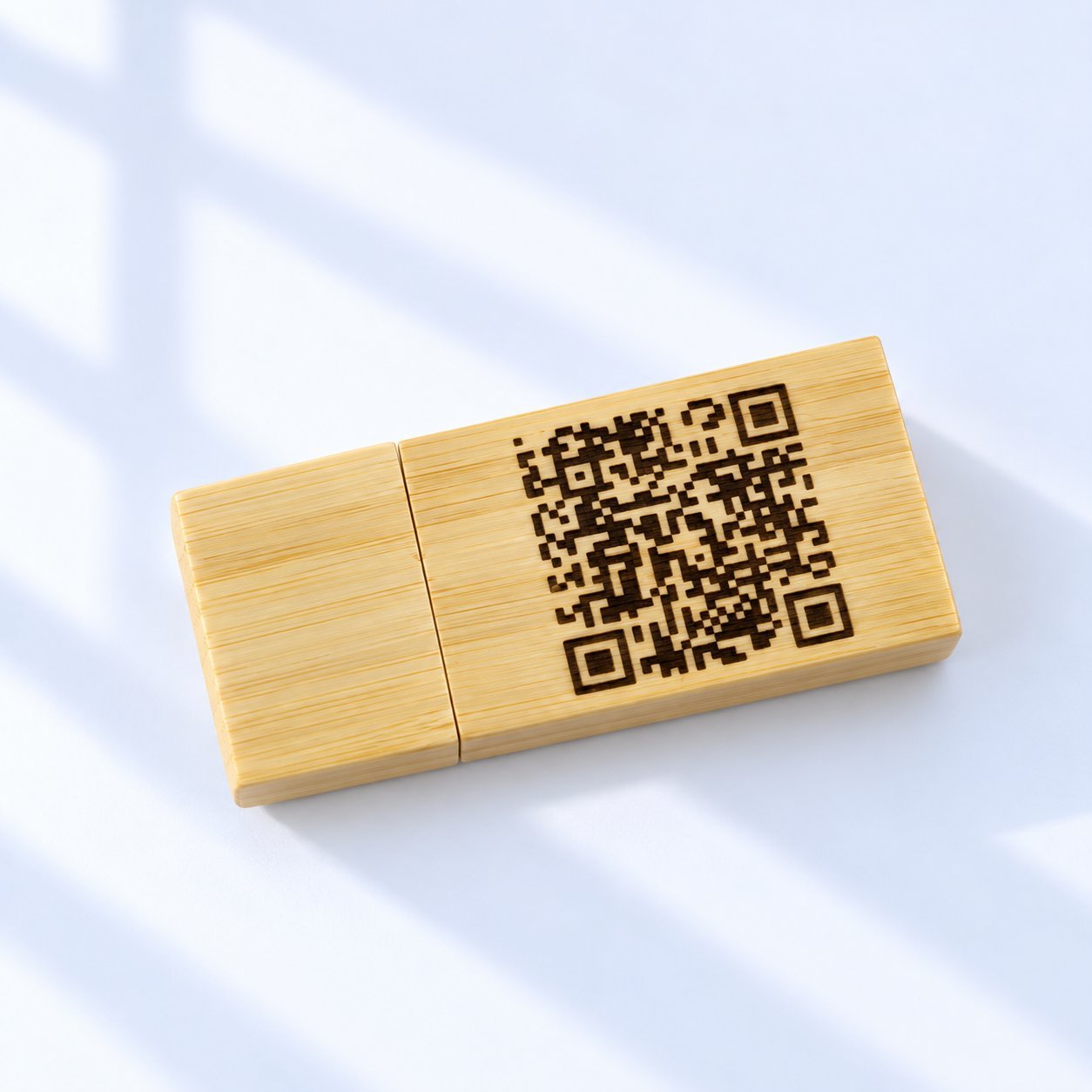
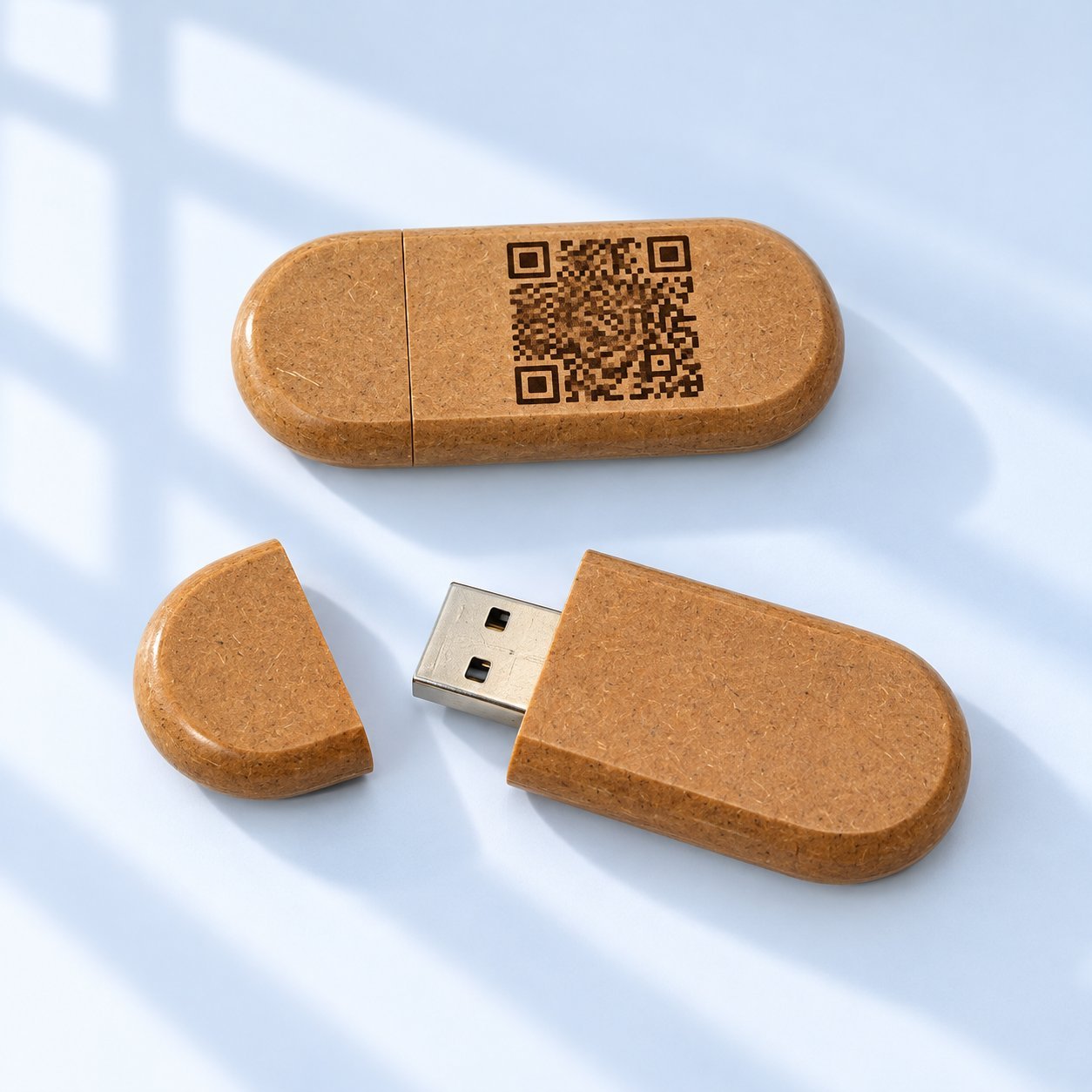
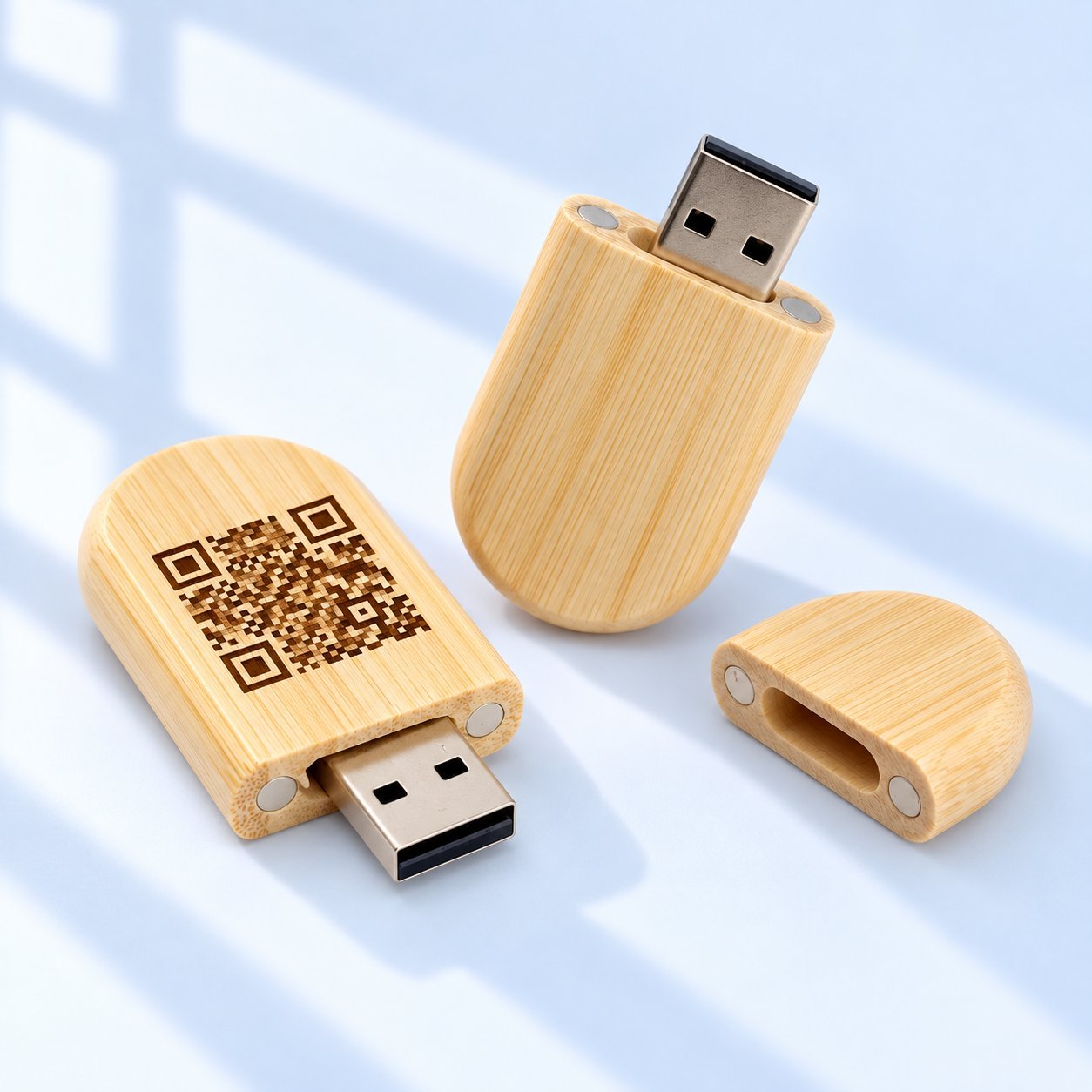
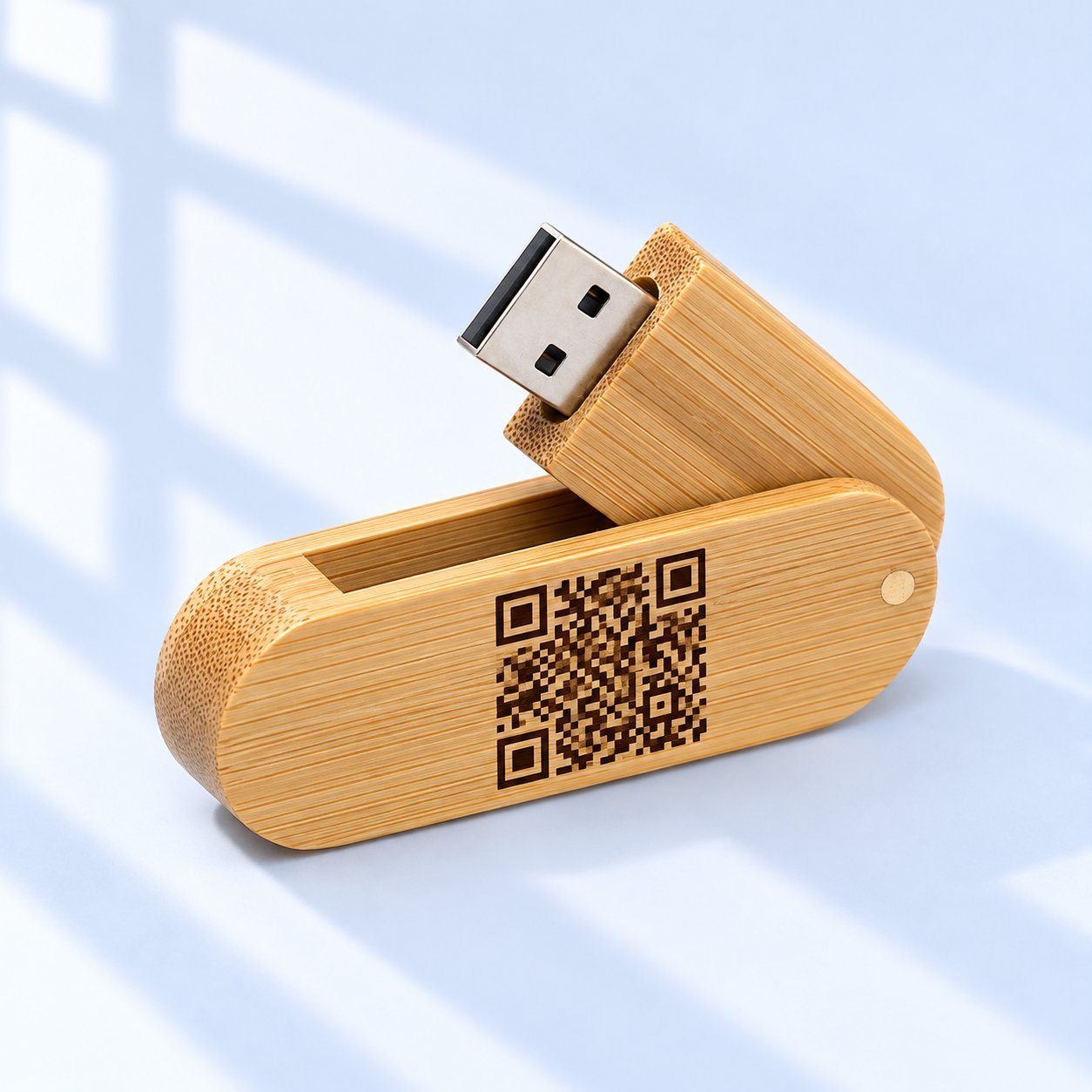
A QR code can be engraved directly onto a wooden USB drive, but scan reliability is condition-dependent — it comes down to the code’s version and module count, the quiet zone around it, contrast against the wood, the drive’s usable engraving area, and the destination URL you point it to. Engraving small on light wood is the hardest combination to get right; UV printing or placing the code on the box or an insert is usually easier. Whichever method you choose, approve a physical sample scan-tested under the actual conditions the code will be used in — not a fixed guarantee, but a real acceptance test.
A logo or a short name has some tolerance for imperfect engraving — a slightly soft edge or an uneven line still reads as a logo. A QR code has much less tolerance, since a scanner is resolving fine module-by-module detail rather than recognizing a general shape. That’s what makes this one of the few customizations on a wooden USB drive worth proofing physically before, not after, you commit to quantity.
Why a QR code is a different challenge than a logo or name
Two things make QR codes harder than typical engraving or printing: the space required, and the contrast required. A logo can be legible at a smaller size than a QR code needs to be, since a scanner is reading fine module-by-module detail, not general shape recognition. And unlike a logo, where wood grain texture is mostly a cosmetic consideration, grain and tone directly interfere with a scanner’s ability to distinguish a code’s dark and light modules from each other.
This project’s companion small text and fine-line logo artwork checklist covers artwork-size verification generally — a QR code needs everything in that guide’s approach, plus the QR-specific sizing and contrast requirements below.
Comparing your three placement options
| Метод | Scannability | Долговечность | Usable area | Внешний вид |
|---|---|---|---|---|
| Engraved directly on drive body | Hardest to get right — small area, wood-grain contrast risk; needs sample testing to confirm | Permanent, part of the drive itself | Limited to the drive’s usable engraving surface, often the tightest constraint | Consistent with an all-engraved design; visible wood-tone variation between units |
| UV-printed on drive body | Easier — sharp black-on-white contrast achievable with a white underbase regardless of wood tone | Depends on coating/finish; confirm wear resistance with your supplier | Same physical space limit as engraving, but contrast isn’t grain-dependent | Adds a printed element alongside any engraved logo |
| On box, insert, or packaging | Easiest — packaging generally offers the most contrast and size flexibility | Tied to the packaging, not the drive — won’t travel if the box is discarded | Effectively unconstrained compared to the drive body | Keeps the drive’s engraved design uninterrupted |
Use this as a starting comparison, not a ranking — which option is “best” depends on whether the code needs to stay with the drive permanently or just needs to reach the recipient once.
Two ways to put a QR code on a wooden USB order — and their trade-offs
Engraved directly onto the drive body. This keeps the code permanently on the drive itself, but runs into both the space and contrast problems described above, since a typical USB drive’s engraving area is often under an inch wide — the same usable-area constraint this project’s companion legibility guide measures for logos and text. Measure your specific drive model’s actual usable area rather than assuming this figure applies to your SKU. Light wood species can also produce lower contrast between an engraved module and its background, since both may end up a similar tan tone — treat this as a risk to validate with a sample on your chosen species, not a guaranteed failure.
UV-printed onto the drive, or placed on the box/insert instead. UV printing can achieve a sharp, high-contrast black-on-white QR code regardless of wood tone, if a white underbase is used under the code — the same underbase consideration covered in this project’s brand-color-matching guide for colored logos on dark wood. Placing the code on the gift box, an insert card, or packaging instead of the drive body sidesteps the engraving-area size limit entirely, since packaging generally offers far more usable space — and it’s the approach YOUSAN already uses for trade-show follow-up QR codes, placed on the box rather than the item itself, as shown in the trade-show USB drive guide.
Sizing: a starting point for testing, not a fixed rule
Treat every figure below as a starting point to test from, not a hard floor — actual size needs depend on the final QR version and module count you generate, the quiet zone around it, your printing or engraving process, and your expected scan distance.
| Requirement | Starting guidance | Why it matters for a wooden USB drive specifically |
|---|---|---|
| Rough minimum QR size | Roughly 2cm × 2cm (0.8in) as a starting point to test from, not a guaranteed working size | A typical USB drive’s engraving surface is often smaller than this once you account for the required margin — measure your specific drive’s usable area, then generate the code and proof it physically |
| Scan-distance sizing rule | Code width roughly one-tenth of the expected scan distance, as a starting ratio — the actual number depends on your final QR version and print/engrave quality | Promotional USB drives are typically scanned at close, handheld range, which is the easier case, but still needs physical confirmation, not just the ratio |
| Quiet zone (margin) | Clear space equal to about 4 modules, or roughly 10-15% of the code’s width, on all sides, with no other artwork encroaching | Easy to lose track of on a small, busy drive body already carrying a logo or text — the QR code needs its own dedicated space |
| Wood-specific engraving minimum | Engraved codes on wood commonly need a larger working size than the same code printed, since grain texture interferes with fine module detail | This is the crux of the space problem — a size that would engrave a clean logo may still be too small for a QR code specifically, and only a physical sample confirms the actual minimum for your drive and wood species |
Table reflects general QR-code standards and wood-engraving practice, not a stated YOUSAN specification. Generate your actual QR code at your intended final size, in your intended wood species and process, and scan-test that specific sample — don’t assume any number in this table transfers directly to your SKU.
Contrast and error correction
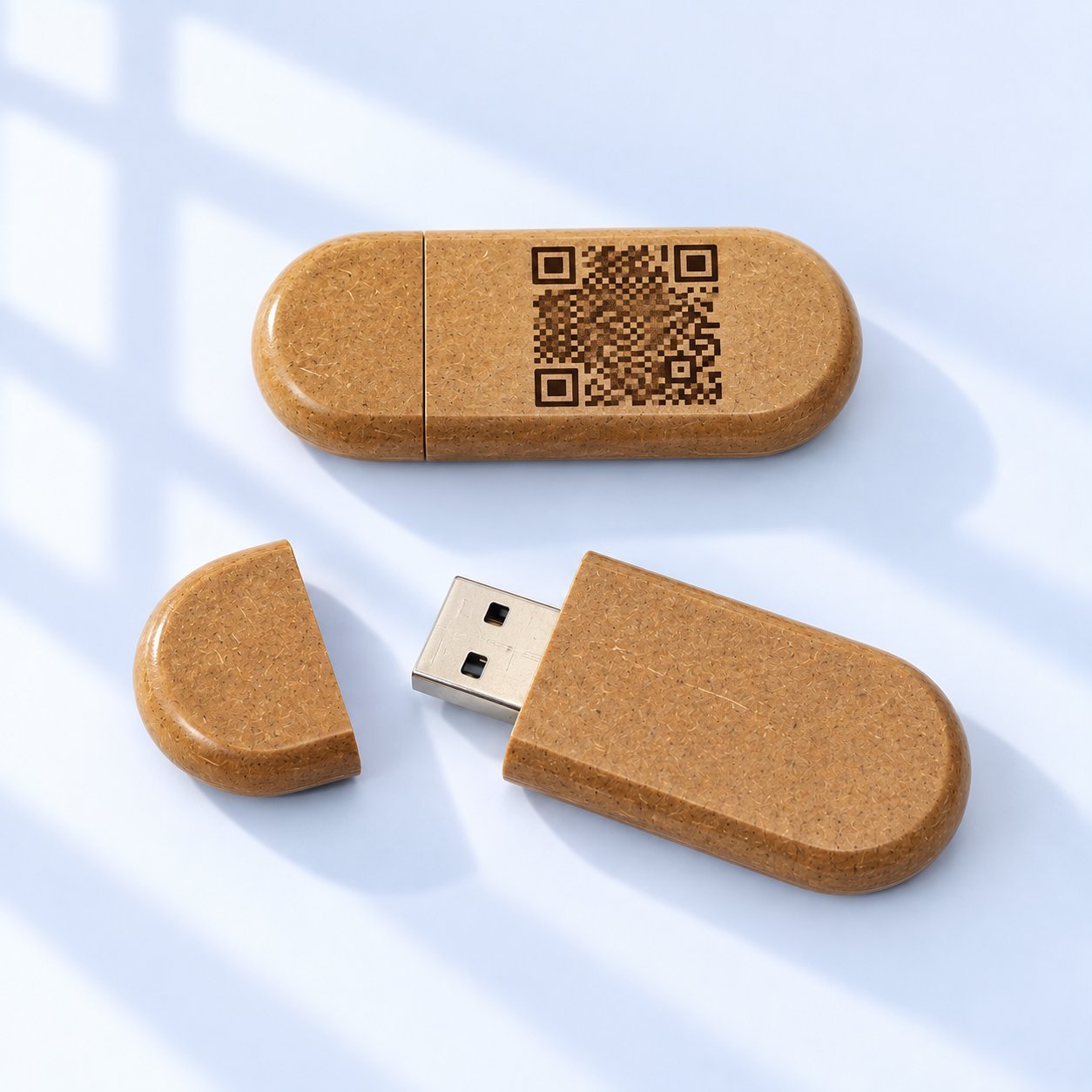
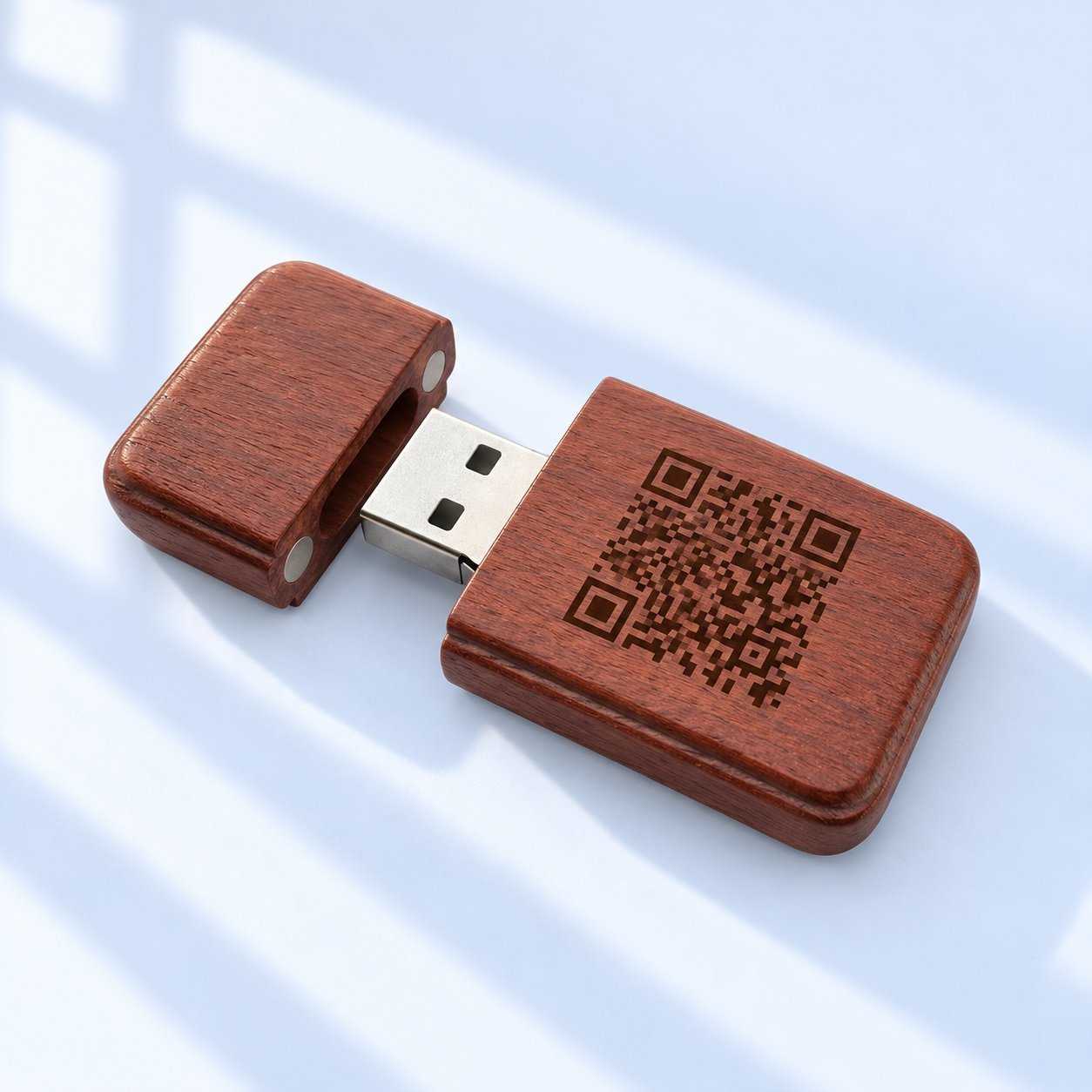
If you’re engraving the code directly, choose a darker wood species where possible, since a light wood like maple engraved with a similarly light burn mark creates poor contrast between the code’s modules — validate this on a physical sample rather than assuming it either works or fails outright. Some suppliers can fill an engraved code with dark wax or ink afterward specifically to boost contrast — ask if this is available if you’re set on direct engraving over UV printing.
Error correction level is a trade-off, not an automatic upgrade: a higher level (the levels run Low, Medium, Quartile, High, per the QR standard) tolerates more damage or obstruction, but it also increases the code’s density, which can make an already space-constrained engraving harder to resolve. DENSO WAVE’s own explanation of QR error correction — the format’s original developer — is the primary source for how these levels work and what damage tolerance each one targets. Choose a level based on your damage risk, your available engraving size, and your scan distance, then validate the actual artwork on a physical sample rather than defaulting to the highest level as a universal rule.
Plan for the code’s entire lifecycle, not just the first scan
A QR code that scans perfectly on day one can stop working later if its destination breaks. Before you approve a bulk run, confirm you own or control the destination URL long-term, that it’s served over HTTPS, and that it won’t be deleted, redirected without your knowledge, or replaced by an expired campaign page. If the URL ever needs to change, use a permanent redirect from the original address rather than reissuing a new code — the physical code on a shipped drive can’t be swapped. Re-test scanning after the product ships too, not just before, since a change on the destination side can silently break a code that engraved or printed correctly.
Verification steps before you approve a bulk run
- Generate the final code pointing to its final destination URL, confirmed as one you own or control long-term, not a placeholder or short-term campaign link.
- Request a physical sample using your chosen method (engraved or UV-printed) and your chosen placement (drive body, box, or insert), at your intended final size.
- Scan-test the physical sample, not a digital mockup, using more than one phone brand and more than one scanning app, since scanner sensitivity varies.
- Test under realistic lighting, including dim conditions, since a code that scans easily under bright studio light doesn’t guarantee it scans the same way in a dim conference hall.
- Re-test after any coating or finish is applied, since a sealant or lacquer layer can reduce contrast or introduce glare that wasn’t present on the uncoated sample.
- Only approve mass production after the physical sample passes, the same standard this project applies to color and engraving approval elsewhere — a digital rendering is never the final proof, and passing under your test conditions is an acceptance result, not a universal guarantee for every device and environment.
Frequently asked questions
Can a QR code be laser-engraved directly onto a wooden USB drive body?
Yes, but it’s the harder of the three placement options to get reliably scanning, since it combines the tightest usable space with wood-grain contrast risk. Measure your specific drive’s usable engraving area, generate the code at your intended final size, and scan-test a physical sample before committing to a bulk run.
Is it better to put the QR code on the drive or on the packaging?
Packaging generally gives you the most usable space and the easiest path to reliable contrast — YOUSAN already uses this approach for trade-show follow-up codes, placed on the box rather than the drive itself. Choose based on whether the code needs to physically stay with the drive, or just needs to reach the recipient once.
Does the wood species affect whether a QR code will scan?
It can, if you’re engraving directly. Darker wood species generally offer better contrast for an engraved code than lighter ones, where the engraved mark and the surrounding wood can end up too similar in tone — but this is a risk to confirm with a physical sample on your chosen species, not a fixed outcome either way.
What error correction level should I use for an engraved or printed QR code?
Choose it based on your damage risk, available size, and scan distance, not by defaulting to the highest level automatically — a higher error-correction level tolerates more damage but also increases code density, which can work against you on a small, space-constrained drive. Validate your final choice on a physical sample.
How do I know if my QR code will actually scan before I order in bulk?
Request a physical sample in your exact chosen size, material, and placement, generated with your real final destination URL, and scan-test it yourself with more than one phone and app under normal lighting. Treat a passing result as acceptance under your tested conditions, not a guarantee across every device, distance, or lighting situation you haven’t tested.
Tell us your target QR code placement before approving a bulk run
Share whether you’re placing the QR code on the drive body, the gift box, or an insert card, along with your final destination URL and intended wood species — so a scan-test sample can be arranged using your chosen method before mass production, and contrast, sizing, and finish tolerance can be confirmed against your specific SKU and species.
 Русский
  English
  Español de México
  Italiano
  Deutsch (Österreich)
  Français
  Türkçe
  Bahasa Melayu